

In this guide, we’ll break down the freeze and fawn trauma responses, explain how they differ from fight or flight, outline signs to look for, and share practical strategies for healing.
Table of Contents
- What Are the Four Trauma Responses?
- Freeze Trauma Response: What It Is and How It Works
- Understanding the Fawn Response
- Freeze vs. Fawn: Key Differences
- Signs You May Have Freeze or Fawn Responses
- How to Heal from Freeze and Fawn Responses
- Conclusion: Reclaiming Your Power
Most people think of fight or flight when they hear about trauma responses — but two lesser-known reactions, freeze and fawn, quietly shape many of our lives. Most of us are familiar with these stress reactions: when threatened, you either attack the danger or run away from it. But what happens when fighting isn’t possible and fleeing isn’t an option?
These subtle survival patterns can leave you feeling stuck, disconnected, or overly focused on keeping others happy, often without realizing why. They’re not personality quirks or weaknesses; they’re deeply wired responses your nervous system developed to protect you.
Understanding freeze and fawn trauma responses can explain years of confusing reactions to stress and open the door to healthier, more empowered ways of responding.
What Are the Four Trauma Responses?
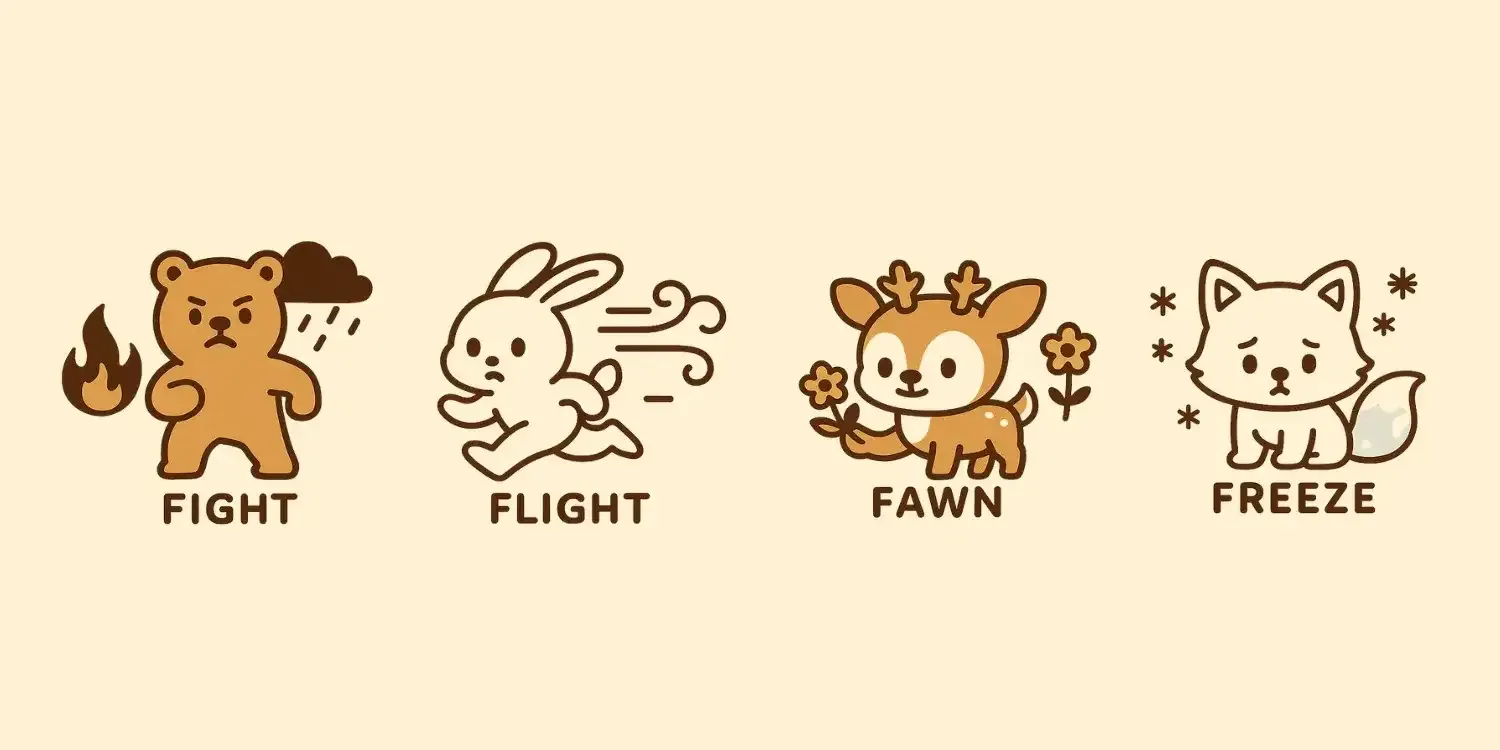
The human nervous system has four main trauma responses — fight, flight, freeze, and fawn — to help us survive threatening situations. Trauma-informed therapy models, such as Pete Walker’s “4 Fs” framework, describe them as core defense mechanisms that form in response to severe stress or abandonment (Walker, 2013).
Most people have heard of fight and flight, but mental health experts stress that freeze and fawn are just as important. Research-based overviews describe all four as “natural adaptive behaviors that help keep us safe by preparing our bodies to react quickly to threats” (Simply Psychology, 2023) and note that they are “triggered by stressful or traumatic situations” (Health.com, 2024).
-
Fight Response: Confronting the threat with aggression or assertiveness
-
Flight Response: Escaping or avoiding the threatening situation
-
Freeze Response: Becoming immobilized when escape seems impossible
-
Fawn Response: Appeasing or pleasing to minimize perceived threat
Freeze and fawn responses often develop in childhood as unconscious survival strategies. They can stay with us into adulthood, quietly shaping our relationships, career paths, and mental well-being.
These are not personality flaws. They are intelligent, hardwired responses your nervous system developed to keep you alive when safety depended on it.
Why We Have These Responses
From an evolutionary point of view, each trauma response increases the chance of survival.
Freeze can help a person go unnoticed by predators, conserving energy and avoiding detection until the danger passed. This idea is supported by predator-avoidance research and Stephen Porges’s polyvagal theory, which links immobilization to a deep, protective nervous system state (Porges, 2011).
Fawn may have evolved as a social survival tool. It helped vulnerable individuals, especially children, stay safe and maintain belonging by encouraging cooperation and defusing conflict. This pattern lines up with attachment theory (Bowlby, 1988).
Freeze Trauma Response: What It Is and How It Works
What Is the Freeze Response?
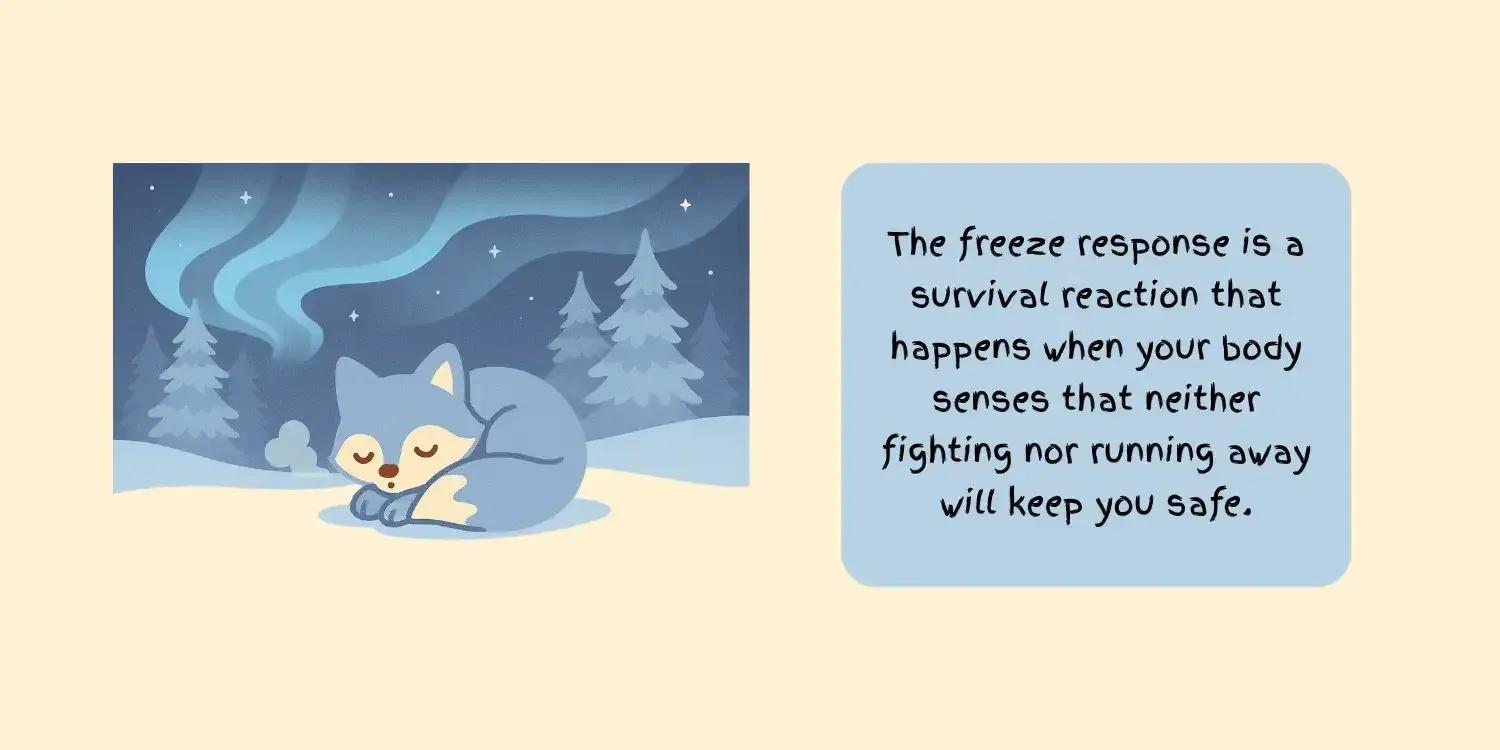
The freeze response is a survival reaction that happens when your body senses that neither fighting nor running away will keep you safe. In this state, your body slows down, your energy drops, and you might feel disconnected from yourself.
According to Stephen Porges’s polyvagal theory, this shutdown mode is connected to the oldest part of the vagus nerve, called the dorsal branch. This branch acts like a brake. When it activates during extreme stress, it slows your body’s systems, lowers your heart rate, and can create feelings of numbness or disconnection. It is the body’s way of protecting you when it believes escape or defense is impossible.
When you are in a freeze state, you might notice:
-
Feeling stuck or unable to move
-
Disconnection from your body
-
Brain fog or trouble thinking clearly
-
Difficulty speaking
-
Emotional numbness or a sense of blankness
Common Freeze Response Triggers
Situations that can set off the freeze response include:
-
Confrontation or conflict
-
Decision-making under pressure
-
Public speaking or performance situations
-
Medical procedures or examinations
-
Intimate or vulnerable moments
Real-Life Examples of Freeze Response
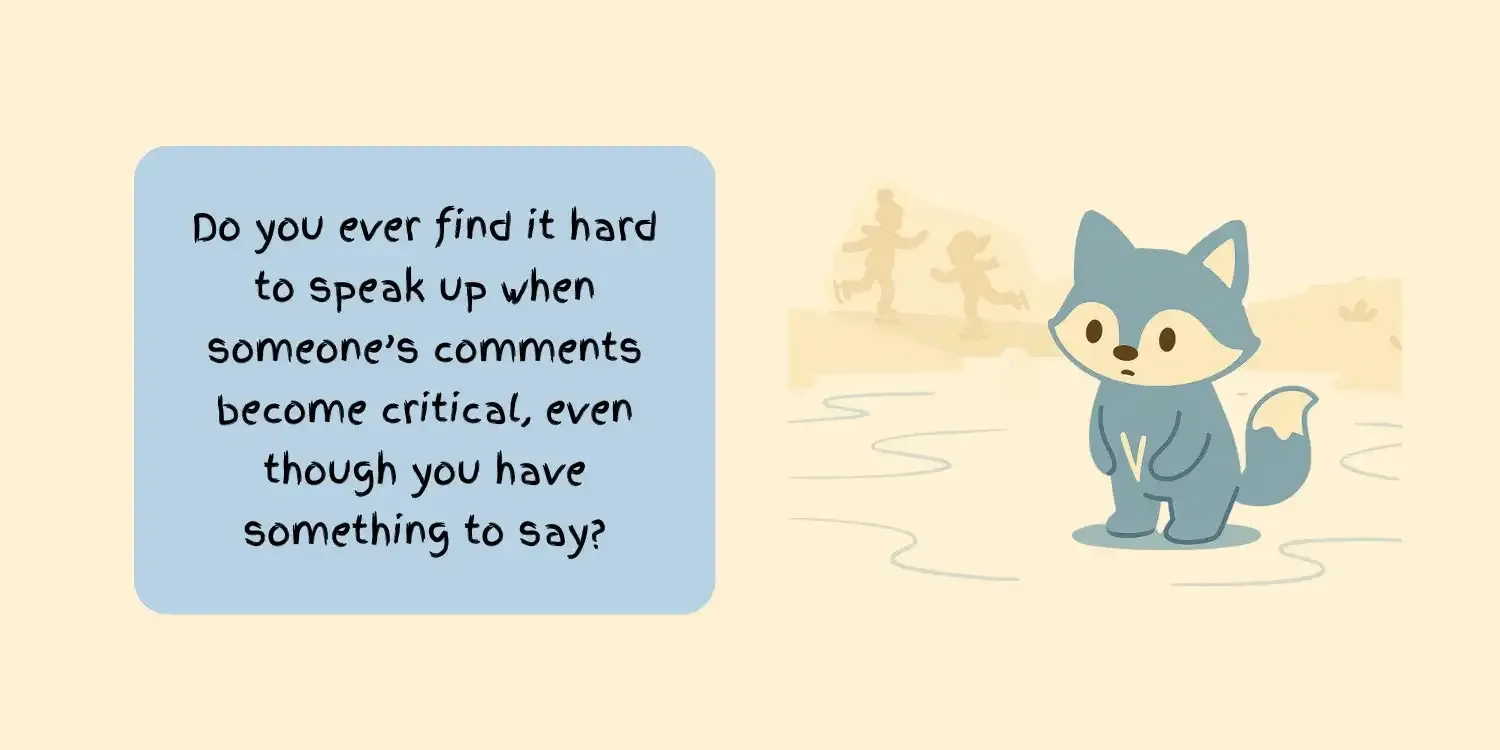
Workplace Example: During a performance review, your supervisor’s feedback turns critical. Your thoughts go fuzzy and you find yourself nodding quietly instead of responding, even though you want to speak up.
Relationship Example: In a serious conversation with a partner, your chest tightens and your mind goes blank. You sit in silence, unable to express yourself even while part of you wants to.
How the Freeze Response Develops
The freeze trauma response often develops through experiences such as:
-
Early-life environments marked by fear or unpredictability
-
Situations where resisting or escaping was impossible
-
Experiencing abuse, neglect, or repeated overwhelming stress
-
Moments where shutting down felt safer than acting
Over time, the nervous system learns that becoming still, going numb, or “checking out” is the safest choice. This same automatic pattern can switch on in adulthood, even in situations that are not life-threatening (van der Kolk, 2014).
Understanding the Fawn Response
What Is the Fawn Response?
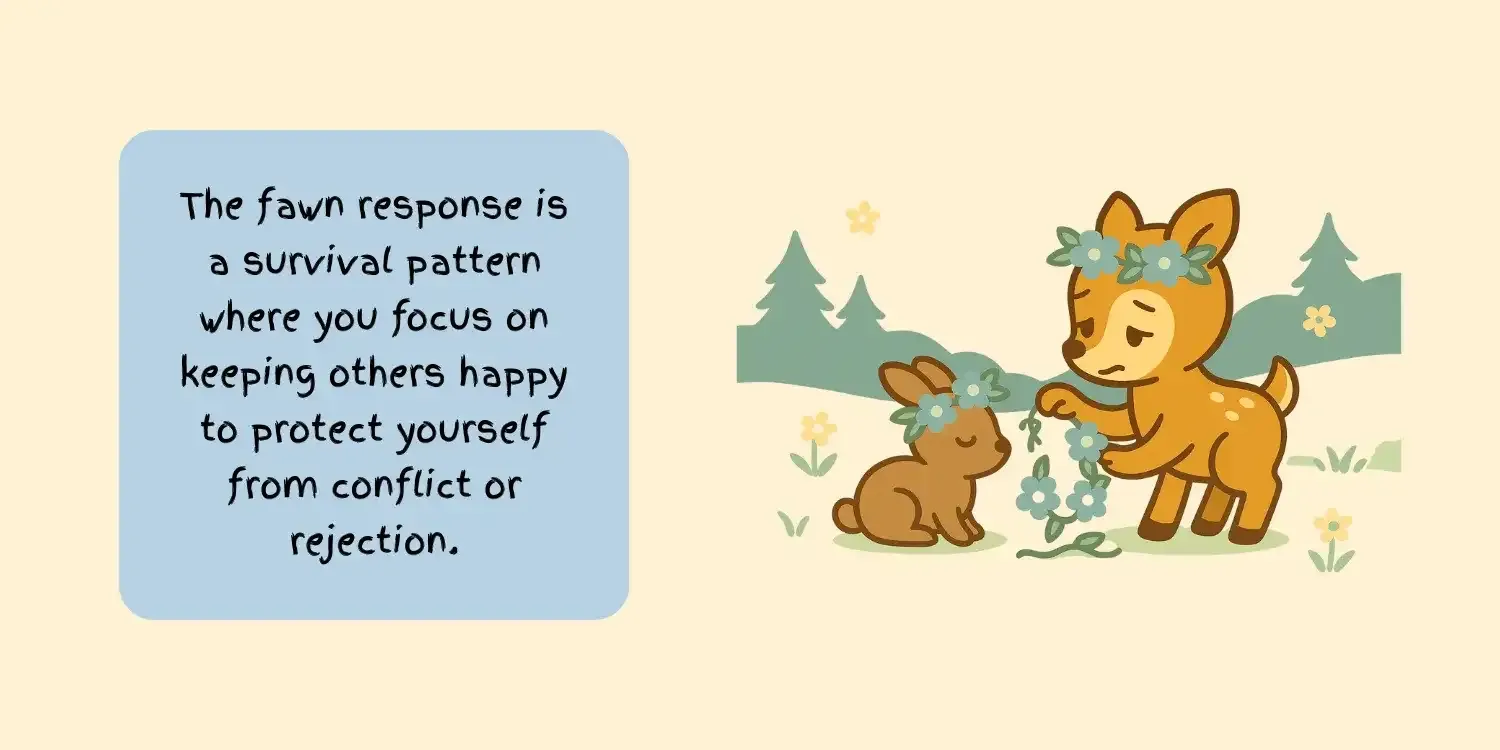
The fawn response is a survival pattern where you focus on pleasing others to protect yourself from conflict or rejection. Unlike the freeze response, which shuts the body down, fawning is active. It channels energy into appeasing and accommodating others to reduce the risk of anger, criticism, or harm.
Therapist Pete Walker introduced “fawn” as the fourth trauma response in his “4 Fs” framework (Walker, 2013). It often develops in childhood, especially in environments where affection or approval was unpredictable. From a nervous system perspective, the fawn response might combine sympathetic activation (gearing up to act) with the social engagement system working in overdrive to maintain safety.
Common signs of the fawn trauma response include:
-
Saying yes when you mean no
-
Over-apologizing
-
Anticipating others’ needs before your own
-
Feeling anxious when someone might be upset
-
Struggling to set boundaries
Common Fawn Response Triggers
Situations that can trigger fawning include:
-
Someone expressing anger or frustration
-
Receiving criticism or negative feedback
-
Fear of being disliked or abandoned
-
Navigating tense group dynamics
-
Conflict with authority figures
Real-Life Examples of Fawn Response
Workplace Example: Your manager asks you to take on an extra project even though you are already at capacity. You agree without hesitation and even thank them for “trusting you,” worried that saying no might affect your standing at work.
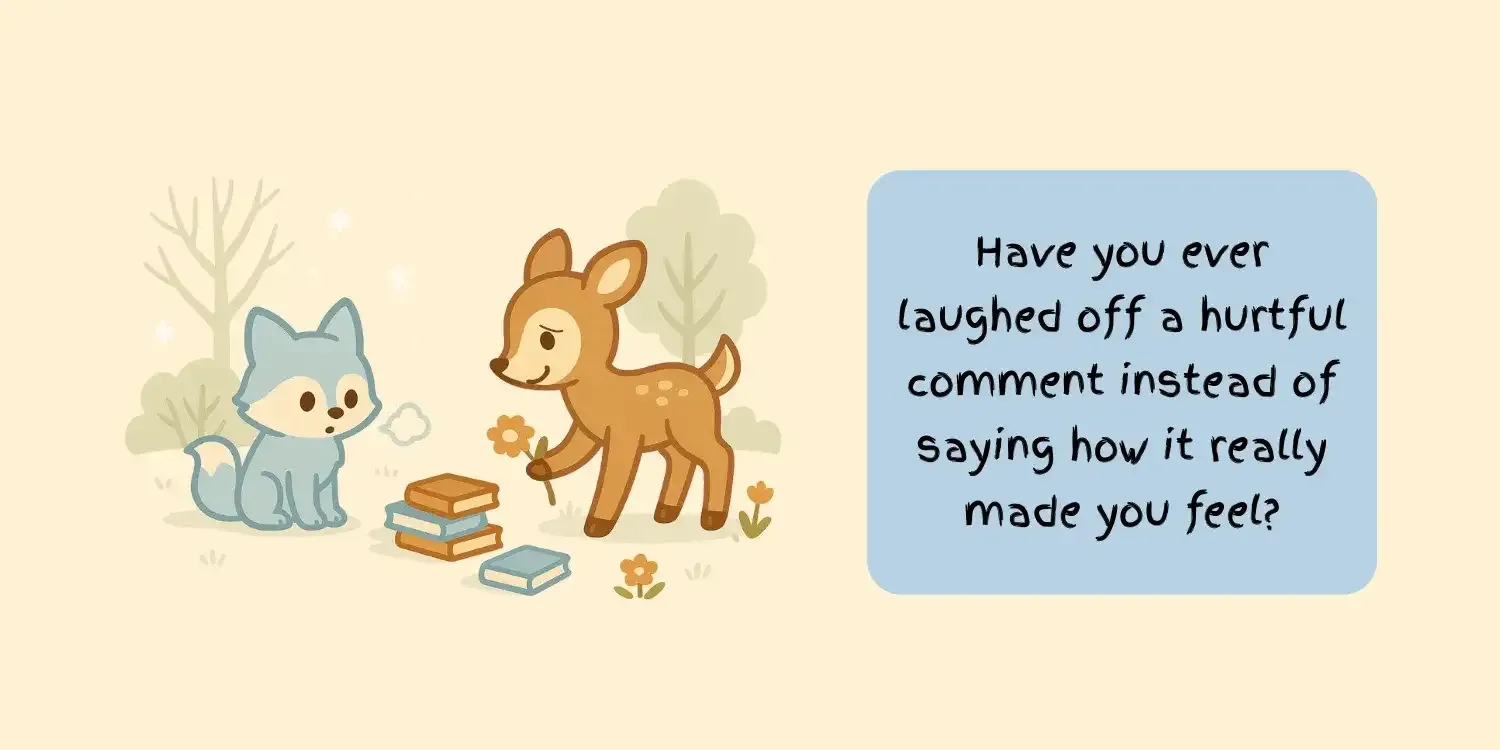
Relationship Example: A friend makes a hurtful comment. Instead of speaking up, you laugh it off and quickly change the subject, focusing on keeping them comfortable so they won’t be upset with you.
The Development of the Fawn Response
The fawn response often develops in childhood environments characterized by:
-
Unpredictable caregivers with volatile emotions
-
Emotional neglect or inconsistent nurturing
-
Narcissistic or controlling family dynamics
-
Situations where compliance ensured safety
Children learn that being “good,” helpful, and accommodating keeps them safe from abandonment, rejection, or abuse (Herman, 1992).
Freeze vs. Fawn: Key Differences
Although freeze and fawn can both develop as survival strategies, they operate in opposite ways. Freeze pulls you inward and still, while fawn pushes you outward into over-accommodation. Seeing them side by side can make it easier to recognize which one you tend to use and when.
| Freeze Response | Fawn Response |
|---|---|
| Physical immobilization | Hyperactive accommodation |
| Emotional shutdown | Hypervigilance to others’ emotions |
| Difficulty communicating | Over-communication or agreement |
| Disconnection from self | Over-connection to others’ needs |
| Appears withdrawn | Appears overly helpful |
| Triggered by direct confrontation | Triggered by potential disapproval |
Can You Have Both Freeze and Fawn Responses?
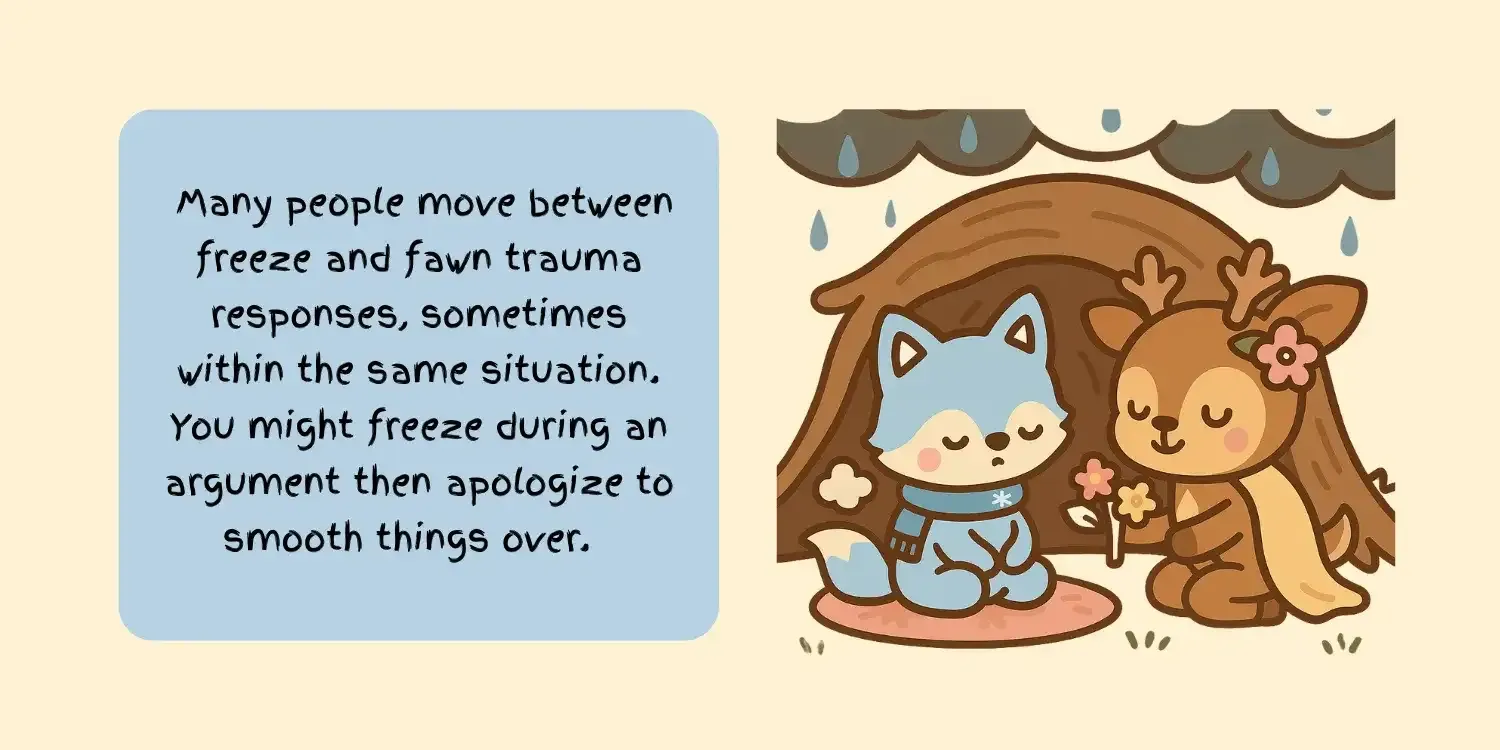
Yes. Many people move between freeze and fawn trauma responses, sometimes within the same situation. You might freeze during an argument — feeling stuck, silent, and unable to think — then slip into fawning by apologizing or over-accommodating to smooth things over. This back-and-forth is common, especially for those who learned early on that staying safe meant both avoiding action and keeping others happy.
Signs You May Have Freeze or Fawn Responses
Recognizing the signs of freeze and fawn trauma responses is the first step toward changing them. These patterns can show up in your body, emotions, and behaviors, sometimes so automatically that you don’t notice until afterward.
Freeze Response Signs
-
Feeling frozen or “stuck” during stress
-
Shallow breathing or holding your breath
-
Emotional numbness or detachment from your body
-
Brain fog or blanking during important moments
-
Avoiding conversations or delaying important tasks
Fawn Response Signs
-
Chronic tension or exhaustion from over-giving
-
Anxiety about disappointing others
-
Guilt when prioritizing your own needs
-
Saying yes when you want to say no
-
Ignoring your needs to keep others happy
How to Heal from Freeze and Fawn Responses
Build Awareness of Your Responses
The first step in changing these patterns is simply noticing them. You can’t shift what you don’t see.
-
Pay attention to when freeze or fawn shows up and identify what triggers them.
-
Keep a small journal and jot down what happened right before the response — over time, patterns will become clearer.
Tip: Be gentle with yourself. These are survival strategies, not flaws.
Work With Your Body (Somatic Approaches)
Your body often needs to feel safe before your mind can catch up.
-
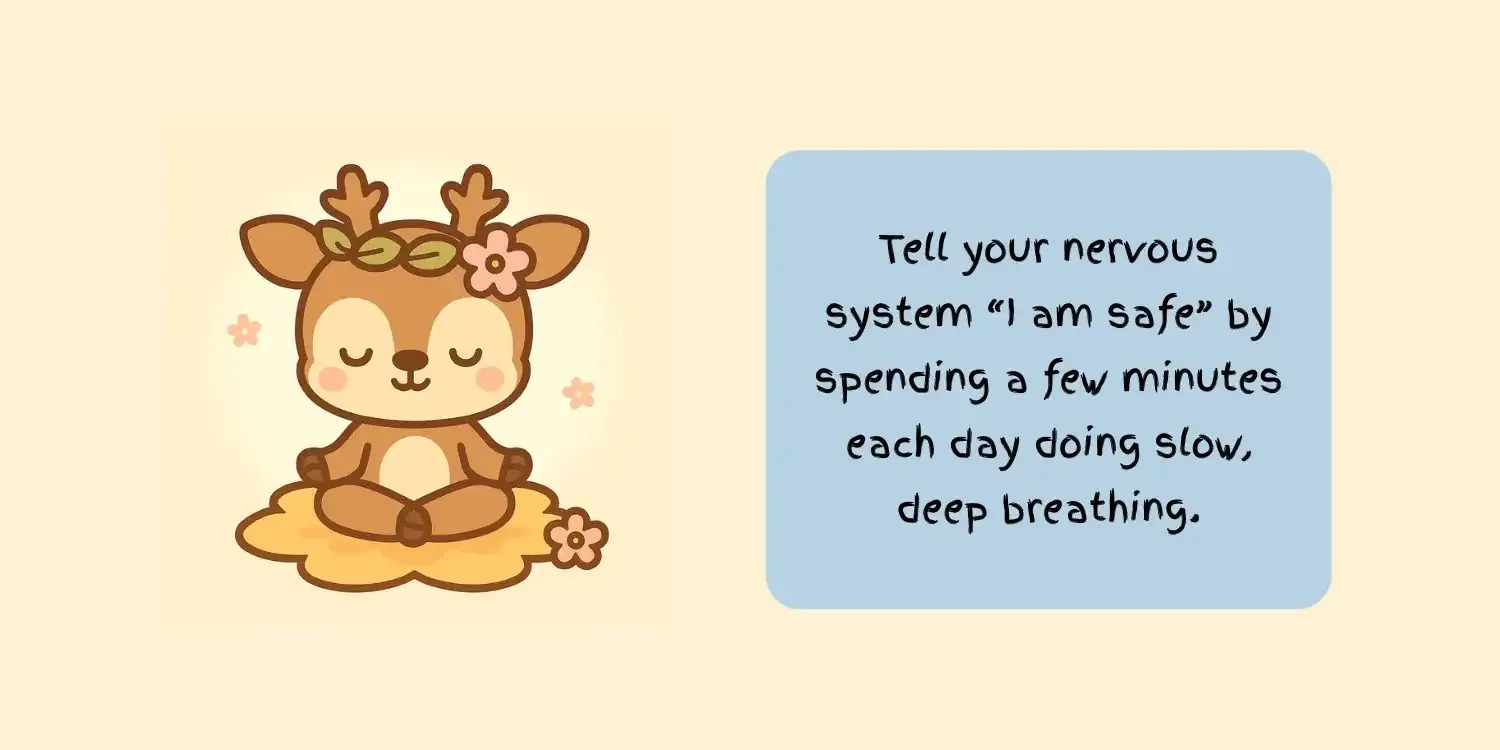
Spend a few minutes each day doing slow, deep breathing (inhale for 4, exhale for 6) to signal safety to your nervous system.
-
Explore somatic approaches such as somatic experiencing, trauma-sensitive yoga, breathwork, or progressive muscle relaxation to help release stored tension.
Tip: Start small. Even gentle shaking, stretching, or placing a hand over your heart can help signal safety and bring you back into the present moment.
Everyday Strategies
-
Grounding: Try the 5-4-3-2-1 sensory method, focus on steady breathing, or splash cold water on your face.
-
Movement: Use stretching, walking, or light exercise to release freeze and restore energy.
-
Communication: Phrases like “I need a moment to think” or “Let’s revisit this later” create space to respond instead of react.
-
Boundaries: Practice small “no’s,” give yourself time to decide, and practice tolerating others’ disappointment.
-
Self-Advocacy: Voice your preferences in low-stakes situations and practice self-care without guilt.
Tip: Grounding and movement are especially helpful for freeze, while boundaries and self-advocacy are key for fawn.
When to Seek Professional Help
While self-help strategies can be powerful, some patterns are deeply rooted and benefit from the guidance of a professional. Consider reaching out for support if:
-
Freeze or fawn responses significantly interfere with daily life
-
You experience panic attacks or intense anxiety
-
Your relationships are being affected by these patterns
-
You feel unable to change these responses on your own
-
You have a history of trauma that hasn’t been addressed
Reclaiming Your Power
Understanding the freeze and fawn trauma responses helps you recognize when you’re in survival mode and gives you tools to respond differently. Whether your default is freezing, fawning, or both, awareness and practice can rewire old responses so you can meet stress with greater choice and confidence.
You don’t have to navigate this alone.
Join a free, trauma-informed peer support Space on Totem.org, where you can share your experiences, learn practical tools, and be part of a safe, understanding community.