


A step-by-step guide to finding your values and actually living by them.
You’ve done the soul-searching. You’ve asked the hard questions about who you are and what you want.
What comes next? How do you actually live in alignment with what matters most?
This is where your core values come in. They’re like a personal North Star; the steady points in life you navigate by when everything else is in constant motion.
In this guide, you’ll discover a simple framework to uncover your authentic values, separate them from the ones you’ve inherited, and start living a life that truly feels like yours.
What Core Values Really Are (and What They’re Not)

Clarity starts with contrast. Before we talk about what core values are, let’s look at what they’re not.
Core values are not:
- Goals you’re trying to achieve
- Traits you wish you had
- Things that sound impressive on paper
- Obligations you think you “should” care about
Once you strip away all the noise and expectations, what’s left are the truths that really guide you.
Core values are:
- The quiet principles that shape what you do when no one’s watching
- The things you’ll stand up for, even when it costs you something
- The qualities you deeply respect in others and try to live out yourself
- The parts of life that feel wrong or empty when they’re missing
💡 Think of your values as your internal operating system: always running, quietly shaping everything you do.
When you live in alignment with your core values, you feel energized, grounded, and clear. When you don’t, life starts to feel heavy, off, or hollow.
Inherited Values vs. Authentic Values
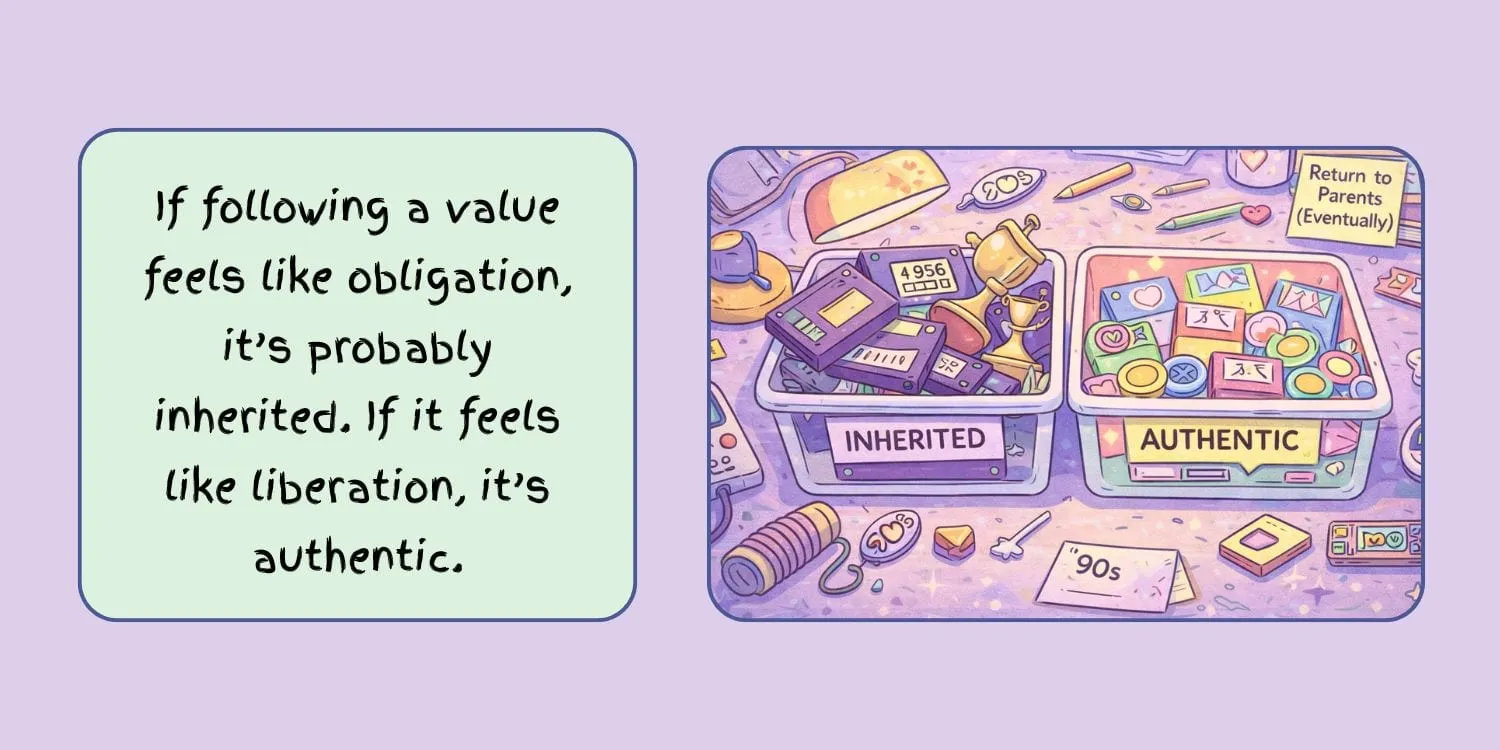
We all start out carrying other people’s definitions of success, love, and purpose.
At some point, you have to ask: Which of these still fit me? And which ones never really did?
Inherited Values
These are the beliefs you’ve absorbed from:
- Family (“Success means stability and security”)
- Culture (“Blend in; don’t stand out”)
- Religion or community (“Sacrifice is the highest virtue”)
- Society or social media (“Busy equals valuable”)
Inherited values aren’t necessarily wrong, but they might not be yours. That’s often why “doing everything right” can still feel quietly wrong.
Authentic Values
These are the ones that live in your gut, not your head. You’ll know them because:
- They give you energy instead of draining it when you live by them
- You’d stand by them even if no one agreed or noticed
- You’ve given up comfort or approval to protect them and didn’t regret it
- They’ve stayed steady through changing jobs, seasons, and relationships
The rule of thumb: If following a value feels like obligation, it’s probably inherited. If it feels like liberation, it’s authentic.
A 3-Step Framework to Discover Your Core Values
Take 30–45 minutes to walk through this process. It’s a small investment that can bring real clarity. Reflecting on your values helps you see what truly drives your choices and where you might be out of sync.
Step 1: Generate Your Values List
Set a timer for 10 minutes and write down every value that resonates with you, even faintly. Don’t edit or analyze.
Here’s a starter list to spark ideas:
Common Core Values:
Freedom • Connection • Integrity • Creativity • Growth • Adventure • Security • Justice • Compassion • Authenticity • Courage • Wisdom • Joy • Impact • Independence • Loyalty • Balance • Excellence • Curiosity • Peace
Fifteen to twenty values should be enough to get you started.
Step 2: Test and Narrow Down
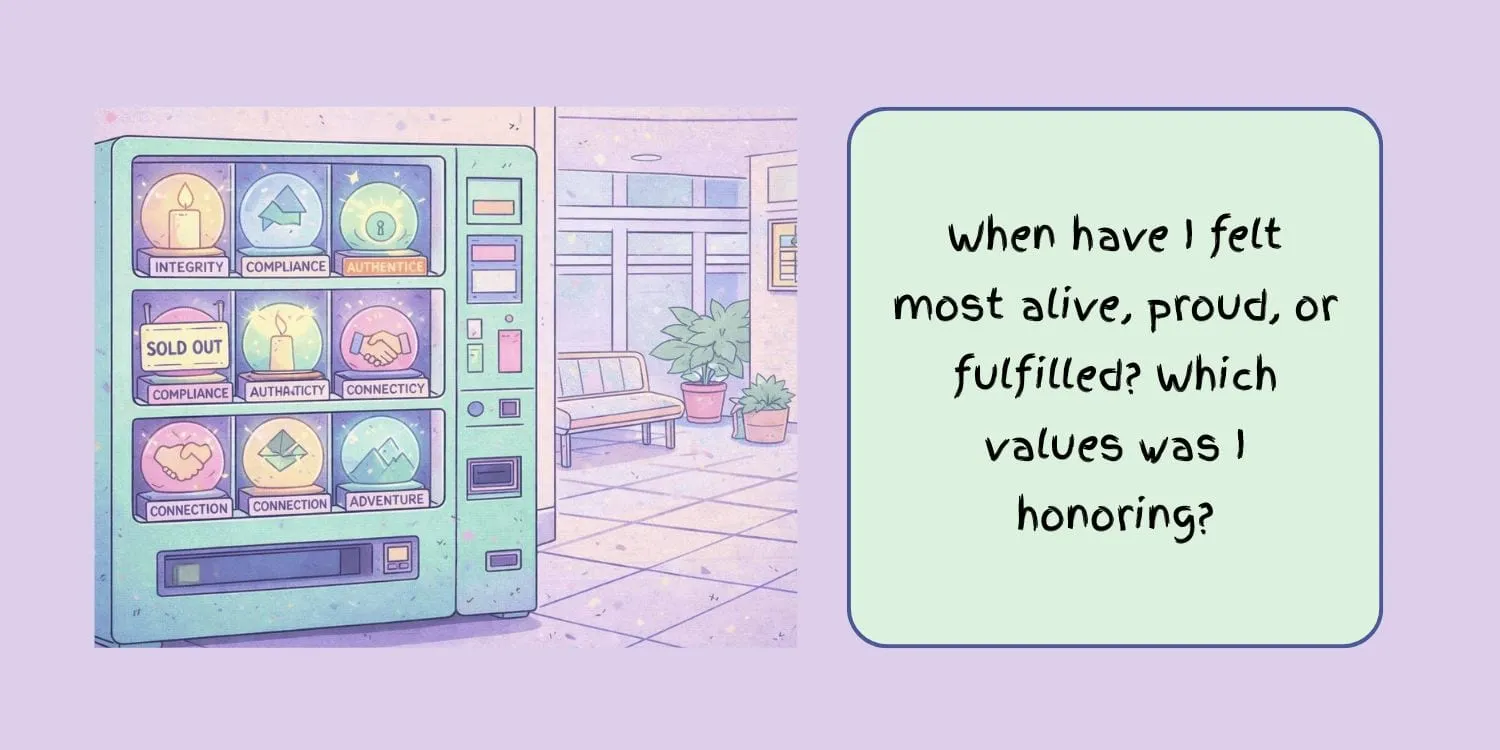
Now, choose the few that really define you.
These questions are adapted from coaching and psychology research on values. They’re designed to help you notice what truly matters to you, not just what sounds good on paper.
Ask yourself these questions for each value on your list:
The Peak Moment Test:
When have I felt most alive, proud, or fulfilled? Which values was I honoring?
The Sacrifice Test:
Would I give up comfort, money, or approval to protect this value?
The Consistency Test:
Has this value stayed important through different seasons of my life?
The Energy Test:
Does this value excite me or pressure me?
Circle your top 10, then narrow them down to your top 5.
These are your non-negotiables, your personal truth.
Step 3: Define What Each Value Means to You
Once you’ve found your top five, give each one meaning. A word like freedom or integrity can mean something completely different to each person.
For each of your top five, write 2–3 sentences about what it means in your life.
Example:
Freedom means:
- Owning my time and energy
- Saying “no” without guilt
- Working in a way that feels natural, not forced
Connection means:
- Deep, honest conversations over surface-level talk
- Quality time with people who see me fully
- Feeling understood, not just liked
That’s how abstract words turn into choices you can actually live by.
Journal Prompts to Go Deeper
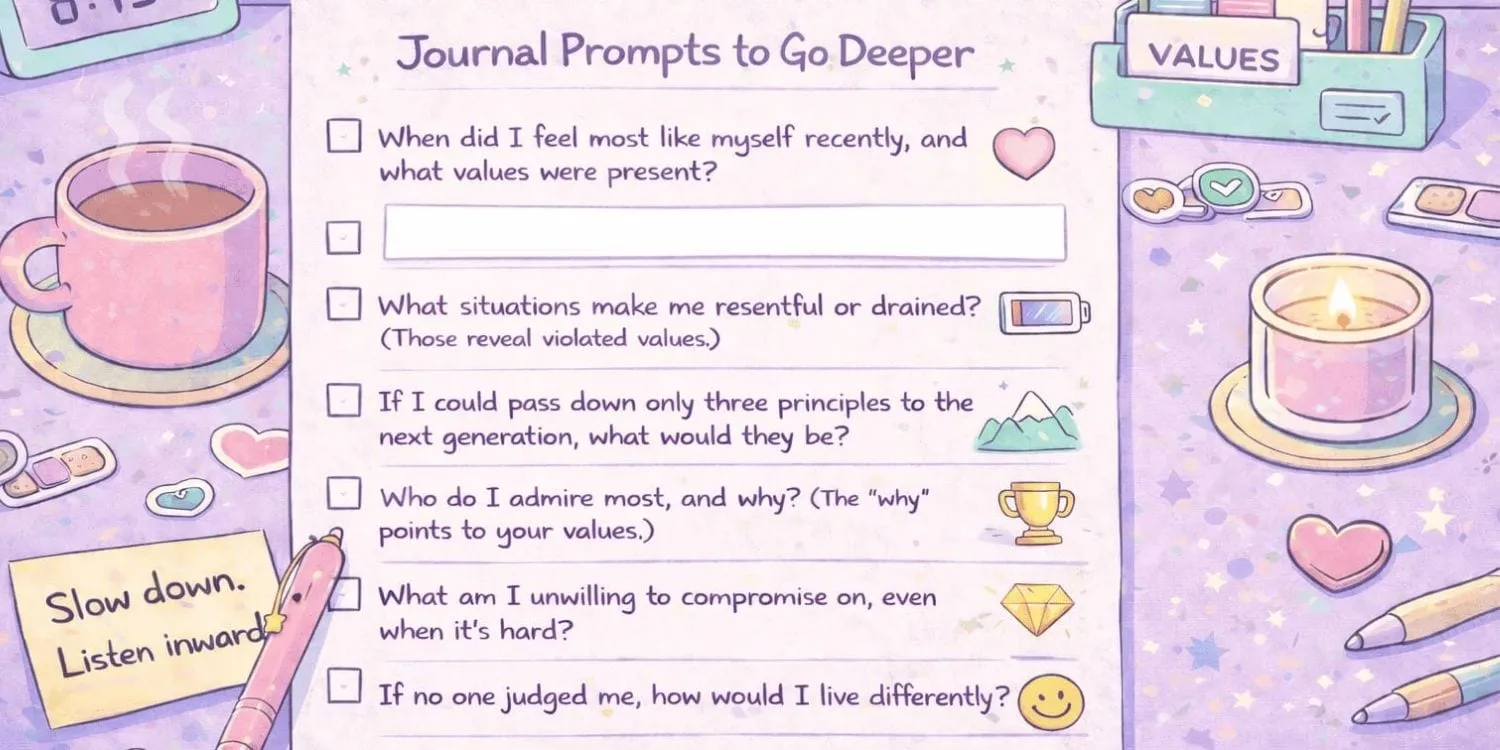
Take a few quiet minutes before you move on. Writing about your values, instead of just thinking about them, helps them take shape. These prompts are a way to slow down, listen inward, and notice what’s already true for you.
Choose three of these now, then come back for the rest later when you want to check in with yourself.
- When did I feel most like myself recently, and what values were present?
- What situations make me resentful or drained? (Those reveal violated values.)
- If I could pass down only three principles to the next generation, what would they be?
- Who do I admire most, and why? (The “why” shows my values.)
- What am I unwilling to compromise on, even when it’s hard?
- If no one judged me, how would I live differently?
- What kinds of people or environments make me feel at ease, and which make me shrink?
- What patterns keep repeating in my life? What value might be trying to get my attention?
How to Use Your Values as a Compass
The Values Filter
When making a big decision, run it through your values.
Example:
Decision: Should I take this new job?
- Does it honor Freedom (autonomy, schedule)?
- Does it nurture Growth (learning, challenge)?
- Does it support Connection (team culture)?
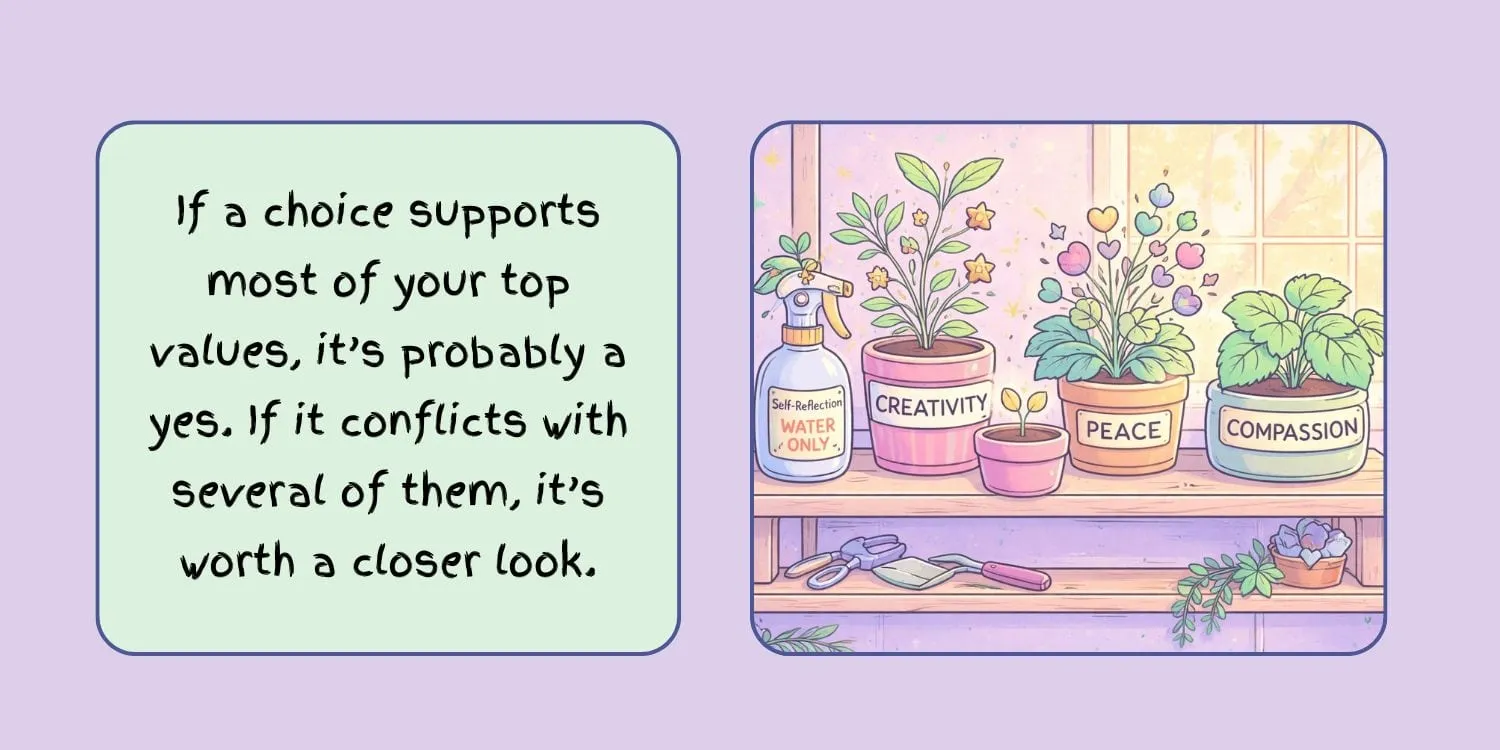
If a choice supports most of your top values, it’s probably a yes. If it conflicts with several of them, especially the ones that matter most right now, it’s worth a closer look.
The Values Audit
Every few months, check in with yourself. Ask:
Am I living in a way that reflects what I say I care about?
Small course corrections now prevent bigger misalignment later.
Living by Your Values Is a Practice, Not Perfection
You’ll slip out of alignment sometimes, and that’s okay.
You’ll take the “safe” job that dulls your spark.
You’ll say yes when you meant no.
You’ll forget.
But awareness changes everything. Once you notice the gap between your values and your choices, you can course-correct, gently and intentionally.
Perfection isn’t the goal. Awareness is.
Your Values Will Evolve; That’s Growth
Living by your values is an ongoing relationship with yourself. You’ll grow, shift, and change; let them stretch and deepen alongside you. It’s proof that life is doing what it’s meant to do.
💡 Ready to explore your values with a community that understands you?
👉 Check out our Spaces Schedule!